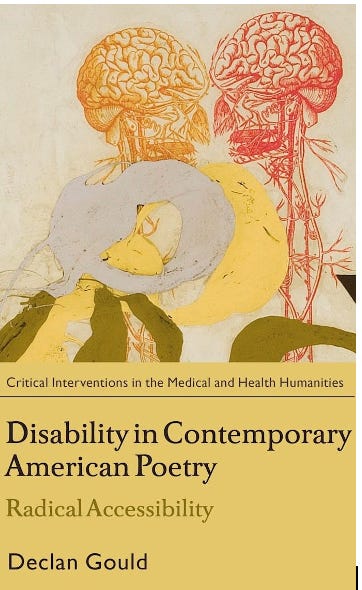
Declan Gould, Disability in Contemporary American Poetry: Radical Accessibility
The Intaglio Review Vol. 3, No. 4
Declan Gould’s book, Disability in Contemporary American Poetry: Radical Accessibility (Bloomsbury 2026), provides a rigorous investigation into the intersection of disability poetics, experimental poetry, and the health humanities. Gould argues that formally innovative disability poetry challenges conventional assumptions about both disability and experimental aesthetics by rejecting the long-standing opposition between identitarian and experimental projects. Rather than viewing disability as a fixed identity that necessitates traditional narrative forms, Gould explores how experimental techniques serve as essential tools for reimagining embodiment and identity. This work positions disability aesthetics as a critical bridge between disability studies and the health humanities, emphasizing the social, material, and experiential dimensions of disability over purely medical models. By expanding the understanding of disability as a discursive and relational experience, Gould demonstrates how poetry can actively reshape cultural conceptions of what it means to be human.A central contribution of this book is Gould’s introduction of radical accessibility, a concept that redefines accessibility not as a static endpoint or a simple removal of barriers, but as a creative and open-ended process. Unlike traditional definitions that focus on the ease of reading or physical usability, radical accessibility suggests that accessibility and difficulty can coexist and even inform one another. Gould builds on the work of scholars like Tobin Siebers and Michael Davidson to argue that aesthetic difficulty in disability poetry is often a direct enactment of the poet’s unique embodied experience. In this framework, non-normative syntax, fragmented forms, and unconventional typography are not errors or barriers to be overcome; instead, they are invitations to collaborate on making meaning. Radical accessibility thus transforms the reading experience into an interdependent encounter that accommodates diverse forms of embodiment and challenges the myths of independence and stability.
Gould situates this research within a scholarly lineage that includes the foundational work of Michael Davidson and Jennifer Bartlett. Davidson’s concept of a poetics of disability, particularly his argument that disability aesthetics defamiliarize both language and the body, serves as a primary theoretical touchstone for Gould’s analysis. While Bartlett, through her co-editing of the groundbreaking anthology Beauty Is a Verb: The New Poetry of Disability, helped establish the Disability Poetics Movement by focusing on visible physical disabilities, Gould seeks to expand this frame. This book complicates the earlier focus on visible impairment by investigating the intersection of poetry and non-visible cognitive, affective, and psychiatric disabilities. By engaging with Davidson’s theories of the defamiliar body and building upon the archival and community-building efforts of Bartlett, Gould provides a more open genealogy of disability poetics that accounts for a full spectrum of neurodivergent and physical experiences.
Gould’s definition of experimental poetry is central to the book’s argument, specifically in how it differs from conventional lyric poetry. Gould characterizes experimental poetry through techniques such as indeterminacy, non-grammatical syntax, and self-reflexive formatting that requires readers to engage with the page in non-normative ways. This stands in stark contrast to the post-confessional lyric, which often relies on a stable, coherent subject and a transparent use of language to convey personal experience. Following critiques by scholars like Intaglio Review’s own Charles Bernstein, Gould suggests that the conventional lyric’s emphasis on linguistic fluency and narrative closure can be damagingly hegemonic. For disability poets, the traditional lyric form often acts as a textual equivalent to an able-bodied gait, enforcing a kind of discipline that hides the realities of atypical embodiment. By choosing experimental forms, poets like Larry Eigner and Hannah Weiner reject the “absorbing” quality of the lyric, instead using “difficult” or “distressing” language to make the material conditions of their bodies and their writing processes visible.
The first chapter of the book examines the typewriter poetics of Larry Eigner and Hannah Weiner, exploring how they utilized the typewriter as a medium to engage with disability as a creative constraint. Eigner, who lived with cerebral palsy, and Weiner, who experienced psychiatric disability, both resisted conventional poetic forms and typographic norms. Their work demonstrates how disability can shape poetic innovation by subverting the rigid grid of the typewriter page to explore the materiality of language. Gould analyzes Eigner’s fragmented syntax and Weiner’s clairvoyant writing to show how their embodied experiences directly informed their poetic structures. By using the typewriter to enact their unique physical and cognitive rhythms, these poets challenged medical models of disability and the social expectations of “normal” writing, proving that disability is a generative force for artistic experimentation that resists the discipline of the horizontal carriage.
The second chapter explores collaborative performance poetry through the work of Amber DiPietra, Denise Leto, and David Wolach, focusing on how they engage with pain and interdependence. Their poetry challenges the reductive stereotype of disability as mere suffering, instead reimagining pain as a force that fosters new forms of collaboration and experimentation. Gould analyzes DiPietra and Leto’s Waveform and Wolach’s Hospitalogy as significant critiques of the hospital-industrial complex, showing how these works reconfigure concepts of time and healing. By moving beyond conventional narratives of cure, these poets create alternative spaces for exploring the relational nature of disability. Their work emphasizes that healing is not necessarily about returning to a normative state but about finding sustainable ways to live and create within a community of interdependent bodies.
The third chapter focuses on how Eleni Stecopoulos and Brian Teare use metaphors of illness and healing to explore the complexities of disability and language. Stecopoulos’s Armies of Compassion and Teare’s The Empty Form Goes All the Way to Heaven are analyzed for their use of proliferative metaphor, dysfluency, and hybrid forms. Gould argues that their poetry challenges reductive critiques of disability metaphors by demonstrating how language can both hurt and heal. The chapter also engages with disability studies’ critiques of ableist language, showing how Stecopoulos and Teare use poetic experimentation to reconfigure the relationship between language, body, and identity. Stecopoulos and Teare demonstrate that proliferative metaphor, rather than being a tool of evasion as some disability studies scholars argue, can be a generative means of holding multiple, even contradictory, states of being simultaneously, refusing the familiar narrative of a return to health. Unfortunately, due to the timing of its publication, Gould is unable to fully address Stecopoulos’s most recent work, Dreaming in the Fault Zone, which Bernstein reviews in this Substack series.
The fourth chapter examines how Bhanu Kapil’s Schizophrene and Claudia Rankine’s Don’t Let Me Be Lonely use experimental narratives to investigate the intersections of race, psychiatric disability, and subjectivity. Gould argues that Kapil and Rankine’s work challenges linear narratives and binaries of normal versus abnormal, instead presenting embodied knowledge as fluid and relational. The chapter explores how their poetry critiques psychiatric discourse, racialization, and the politics of visibility, using experimental forms to reimagine identity, temporality, and intersubjectivity. By highlighting how race and disability are mutually constitutive, Gould shows how these poets use the breakdown of narrative to reveal the structural violence inherent in normative medical and social systems, particularly through the use of unstable pronouns and atemporal episodes.
The book concludes by synthesizing the insights from the preceding chapters, emphasizing the concept of radical accessibility as a framework for understanding disability poetics. Gould argues that experimental disability poetry offers new ways of thinking about embodiment, interdependence, and the politics of access. The conclusion underscores the potential of radical accessibility to challenge normative aesthetics and reimagine the boundaries of poetic form, disability, and identity. Gould calls for continued interdisciplinary dialogue between disability studies, health humanities, and experimental poetry to expand the possibilities of both fields. Ultimately, the book asserts that radical accessibility is not just an aesthetic choice but a social necessity that fosters a more capacious understanding of human difference in an increasingly vulnerable world.
Gould’s argument further extends to a critique of the post-confessional lyric’s containment (Bernstein’s terms), particularly its insistence on a legible identity and a stable moral position. While such forms are often employed in the name of social virtue—seeking to provide a clear, empathetic window into the lives of the marginalized—Gould suggests that this very insistence on transparency can do a profound disservice to the disability experience. By forcing the “distressing” or “difficult” realities of atypical embodiment into the neat, absorbing structures of the conventional lyric, these works risk domesticating disability to fit a normative gaze. This drive for legibility often prioritizes a socially virtuous narrative of overcoming or a clear-eyed moral stance over the more radical, interdependent, and often messy truths of disabled life. In this sense, the post-confessional lyric’s reliance on linguistic fluency and narrative closure acts as a form of aesthetic and political containment that reinforces the very ableist structures it may claim to challenge. By contrast, the radically accessible poetry Gould champions rejects this performative virtue in favor of a “difficult” aesthetic that makes the material and social constraints of disability visible and uncontainable.