Stanley Cavell: In & Out
on his centennial
Foreword and afterword to Music with Stanley Cavell in Mind, edited by David LaRocca (Bloomsbury, 2004)
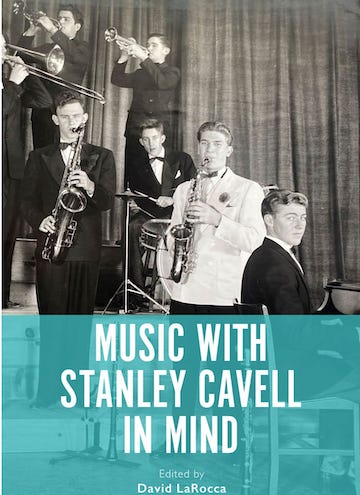
1. In Walked Stanley
🎶 Dizzy, he was screaming
Next to O.P., who was beaming
Monk was thumping
Suddenly in walked Bud
And then they got into somethin’ 🎶
—Jon Hendricks lyrics to Thelonious
Monk’s “In Walked Bud” (1947)1On a human scale, it would seem reasonable to us to accept the idea that sound is understood as melody in a final sense. Texture, silence, the ebb/flow of tension, meter, pitch control, etc: the complete range of all the components finally comes to rest in some kind of melodic realization.
—Julius Hemphill2
I met Stanley Cavell during my first year at Harvard. He was starring in the second part of a year-long history of philosophy, staged twice-weekly on the ground floor of Emerson Hall. In the Fall of 1968, I was swept away by Rogers Albritton’s sinewy commentaries on Augustine, Aquinas, and the Sermon on the Mount (I’d sign up for Albritton’s version of Christianity in two shakes of a sophist’s tail).
In walked Stanley: swerving from Rousseau to Marx to Mill to Nietzsche. And swinging too. God wasn’t dead so much as transmogrified (or is in transubstantiated?) into the possibilities of thought.3 Cavell wasn’t about theorizing but thinking. Each week he talked us through the history of ideas, as if the ideas were the standards that Cavell used to bounce off for his improvised riffs. Something closer to bebop than explanation. All performed with the understanding that what we say, how we use verbal language, matters. Language matters, that is, not just as a way of describing things or as a way of adjudicating things, but as a way of bringing the world into consciousness.
Something I wrote the next year, after one of Cavell’s Walden improvisations, stays with me: We are limited to language but not by language. Cavell showed that consciousness is both individual and shared, because its site is language, which is collective and singular.
Fifty years later, I was back in that same classroom for Cavell’s memorial. I paid tribute to Cavell as a writer for whom philosophy was a genre, not a prescribed mode of exposition; a thinker who was aversive to rationality in the pursuit of reason. I stressed that his wide range of topics––Emerson and Thoreau, Wittgenstein and Austin, Hollywood comedies and Shakespeare tragedies––did not take him outside of philosophy but rather put him at philosophy’s center. Cavell was never eclectic. The objects of his attention together formed a constellation (in Walter Benjamin’s sense).
A central focus for Cavell is how language means. He greatly broadened my ability to recognize the semantic field as something that exists in n-dimensional space. Cavell was at pains not to refute, but to respond to, skepticism––not just to the problem of how we know anything for sure, but also the problem of how we know words mean what they say. His response was that words, as the world, mean by doing, and that we know by responding. Our knowledge of the world is reciprocal: you get what you give, but only if you can acknowledge that.
I am tempted to say that for Cavell, skepticism and analytic logic share an avoidance of music, if by music we mean the performative dimensions of language, the doings, that come to meaning through call and response, testing one thought against another, parry and reprise, variation and extension.4 In Must We Mean What We Say?, Cavell discusses the “temptation” to say something and its reformulation as the Wittgensteinian dialectic that brings “self-knowledge” back in play, after its long exile from philosophy.5 This is not the music of the metronome but the art of the fugue and the practice of improvisation. Cavell was writing the foreword to his first book just at the time I first heard him perform. He called Must We Mean What We Say? “a book of essays”: not papers, articles, or arguments: essays in the sense of tries, suggesting Montaigne more than Aristotle.
Essays are thought set to music; or are they music set to thought? Music is what animates the words just as words animate music. In Little Did I Know, Cavell tells a story about Ben Webster, the saxophonist whose improvisations on Irving Berlin’s “Blue Skies” are echoed by Thelonious Monk’s “In Walked Bud.”6 Webster, Cavell says, “suddenly stop[ed] playing in the middle of a chorus, seeming bewildered. Asked why later, Webster replied that he had forgotten the words.”7 The words of the song, say “Blue Skies,” don’t accompany the song but are part of the music, whether sung out loud or not. When you lose the music, you lose the words (and the other way around).
The philosopher stops in the middle of a talk: “I forgot the music.”
Rationalistic analytics is philosophy without the music.
Rationality without fantasy is tyranny.
Robert Musil marvelously illustrates the musical contrast I’m flagging here. Musil’s immediate target is the “Dichter des Generals,” bloated Idealist poets of the general, those bloviators of the context-free universal sentiment, who Musil compares to Heine, who, like Cavell, is a Jewish master of the ingenious interstitial weave. But might we not also hear, in this passage from Musil, a critique of the Vienna Circle, who were part of Musil’s cultural milieu:
His ceremonious idealism echoes the deep, low instruments in the orchestras, which resemble locomotive boilers raised up high spewing unaccountable grunts and bellows. They cover with one sound thousands of possibilities. They blow big balloons full of eternal feelings.8
I want to shift the frame from Cavell on music to Cavell as music. What if we read Cavell as poetic or literary writing rather than as philosophical argument, as opening up reason to “thousands of possibilities” in contrast to a narrowing of rationality to one possibility as time? Cavell’s work enacts an aversion to rationality in the pursuit of reason as he moves from “the claim to rationality,” the title of his dissertation, to “the claim of reason,” the title of the book that comes out of it many years later. Of course, it is possible, even common, to argue for multiple possibilities within a rational discursive plain. But Cavell’s writing averts that chiasmus.
Rogers Albritton’s dissatisfaction with writing, which he shared with Wittgenstein, is related to the kind of flattening of discourse he would have found in much of the professional philosophical writing of his contemporaries: small balloons (not to say ballrooms) of eternal truths. In his improvised, talking philosophy Albritton did give the sense of sounding thousands of possibilities. I remember Rogers telling me that something I wrote didn’t have an “ear” for the philosophical terms I used (mine was always sore thumbs). Cavell understood the problem that kept Albritton from writing, but he was not deterred. “At some point in Beethoven’s work you can no longer relate what you hear to a process of improvisation. […] At that point music, such music, must be written.”9. Cavell was able to put the talking/performative—stand-up—philosophy of Albritton, Austin, and Wittgenstein into writing, but not without difficulty. Still, he had practice from early on: as a teenager he reports “spending every night in my room imitating and transcribing for hours the clarinet improvisations from Goodman and Shaw recordings.”10
During his talks for the 1968 class, Albritton introduced Aristotle’s hoary distinction between energeia and kinēsis. I know that e and k go together like a horse and buggy or labor and its fruits. Myles Burnyeat calls the Aristotelean source text for this distinction a “freak performance” and would be skeptical of the attention I want to give it; but maybe a “freak performance” is just what I want. Evidently, e as “seeing” versus k as “building something” is more accurately covered by e vs dynamus.11 In an apparently unrelated article, Burnyeat takes to task Thompson Clarke, Cavell’s comrade-in-skepticism, for what Burnyeat characterizes as a kind of freakish Pyrrhonism, where everyday consciousness is insulated from the philosophical exercise (excess) of skepticism.12 I’m still looking for the tune, something bluesy, but the words might go something like this: 🎶 I believe I don’t know and better believe me, baby, I know I don’t believe 🎶. I imagine Burnyeat shaking two fists at latter-day Sirens Clark and Cavell in an homage to G. E. Moore. (“Progress is our most important product,” as the GE ad used to say.) —I’d propose that skepticism is a blowback of k (which is why I spell skepticism with a k as the second letter rather than a c) that can be resolved by the formula e = mk2, where m is music. If you can’t hear the music, you lost the meaning of the words: 🎶 It don’t mean a thing if it ain’t got that swing 🎶.[13
As it socked me in ’68, k is a means to an end, something for the sake of something else; while e, is something that needs no justification, evoked for me that year by John Coltrane’s Ascension. In my 1968 freakish pata-Aristotelianism, the analogy to k vs e would be amphetamine vs. mescaline. War was our demonic kinesis. We were in the streets protesting a means to a bad end: “US out of Vietnam, Harvard out of Gulf.” In 1968, energeia attracted me, like Emerson’s moral perfectionism, as Cavell later echoed it; or maybe something else out of Aristotle’s era, the Bhagavad Gita.
As 1969 dawned, but before the Harvard Strike, I was sitting in another lecture room in Emerson Hall, trying to hear what Willard Van Orman Quine was explaining in Symbolic Logic 101. Unlike the delightful, lucid wit of his essays, Quine mumbled through his lectures, rarely turning toward the students, never engaging us directly. Symbolic Logic, I gathered, jumping the gun, was kinesis, not a pure mathematics but a means to an end (or maybe artificial intelligence avant la lettre).
In Must We Mean What We Say?, Cavell makes the distinction between positivists and “post-positivists.”14 He treated the history of philosophy the way Coltrane treated “My Favorite Things”—motifs to spin, themes to try on, possibilities to consider. This was energeia: music to my ears. It wasn’t just Quine, whose identification with the political right made him an even easier target for the likes of me. The altogether liberal John Rawls was another kinesis guy, though the ends of his argument were admirable. Quine and Rawls—and Aristotle too—were acrobatics of deductive, rather than inductive, reasoning. Cavell was dance.
E = outside the bounds of logic but inside the limits of reason alone. In other words: do not make an argument to prove what you think but rather write an essay to find what you think.
In his essays, Cavell is not making an argument, he’s finding arguments. His sentences are not in the service of a foregone conclusion but a tool for actively inconclusive thinking, even when he comes to conclusions. His writing is difficult or obscure if you expect deductive rationalization. For those who prefer improvisation, the work is a musical delight, where music marks the embodiment of language in the act of composition. Cavell plays the scales of reason, sounding each note in different pitches, so we may find our way through the traps and allures. Syncopation, echo, reverse, recapitulation, extension: arguments become tunes that are sounded, sometimes till where you almost think it’s lost and then it comes back again, only now you hear it not as linear but in multidimensional space. Recombinant, recursive, inferential, associative—what I call echopoetics. Hemphill writes of exploring “the possibilities of a redistribution of usual rhythmic functions so that the role of rhythm is more diffuse.”15 I want to say that Cavell redistributes (constellates, arrays) the argument, logic, themes, motifs, topoi, topics, subjects.
Imagine for a moment that the standards Cavell improvises on, through impromptus, themes, and variations, are keynote motifs: sometimes tonal and sometimes outside the tune, sometimes syncopated and sometimes dissonant. In Must We Mean What We Say?, Cavell provides a stunning “thematic index,” itself a kind of list poem:
Acceptance, acknowledgment (and its refusal), alienation, America, answer, audience, belief, bring words (or the mind) back, comedy, confession, convention, conviction, criticism, dialectic, difficult, dogmatism, dreaming, epistemology, everyday language, fashion, forgetting forms of life, fraudulence, freedom, God, grammar, heightened meaning, history, intention, interpretation, intolerance, knowing, language and fact, learning, listening and hearing, literal and figurative, logic, medium, modern, modernism, morality, natural and unnatural, necessity (and need), new criticism, normative obscurity, obviousness, ordinary and extraordinary, ordinary language philosophy, Oxford philosophy, particular case or occasion, performance, perspective, phenomenological facts, philosophy (and art, audience, common “belief,” distraction, ideology, impotence, madness, memory, paralysis, impatience, poetry, irrelevance, science, theology, tragedy, wonder, world brought to consciousness), picture, post-positivist, presentness, prophesy, psychology, questioning, revelation, revolutionary, saying and meaning, self-knowledge, separateness, silence, singleness, sitting quietly in a room, skepticism, speaking, stopping, taste, teaching, terms of criticism, totally in view, tradition, tragedy, transcendental logic, wonder, words, world, writing.16
Only Cavell’s autobiographical writing on his younger days focusses on jazz. Nonetheless, improvisation is an ongoing motif, sometimes in counterpoint to chance and composition and other times as setting, as with his remark on Beethoven: when improvisation stops, writing begins. Arnold Davidson, in an essay mostly on Sonny Rollins, published in a collection edited by George Lewis, makes a compelling argument that Cavell’s Emersonian approach to Moral Perfectionism offers a valuable approach to critical improvisation studies.17 In any case, it is of fundamental value to bring these too often competing discussions of music together, much the way Cavell brought Emerson and Thoreau into philosophical play, over and against those who discounted them as “merely” literary writers.
Doing things with words (do is an instrument): In Little Did I Know, Cavell writes about his purgatorial year as a UCLA philosophy student:
I would occasionally pause for an hour improvising on show tunes, perhaps to keep in touch with the somehow reassuring remnants of an old talent, perhaps for the sheer pleasure of invoking the exuberant and so often perfect, if from a certain perspective limited, American accomplishments in popular words and music, effortlessly including the unfathomable inspiration of its grateful and resourceful immigrants.18
Dial back a few years. Cavell’s father gives him an alto saxophone as a belated Bar Mitzvah present.19 You don’t have to be a Jacques Lacan to see the symbolic power of this gift: the Word is music. Traditional Bar Mitzah presents, in addition to money, include pens and dictionaries (Cavell’s immediate contemporary, poet Larry Eigner, got a typewriter). The Bar Mitzvah is the moment a young person presents himself to the congregation as a full member through cantillation (chanting) of the Torah. The saxophone, often heard as speaking or singing, giving melody to sound, marks, as in The Jazz Singer, the reframing of the congregation as American as much as Jewish, inspired by “resourceful immigrants,” such as Irving Berlin. This moment also anticipates, not so many years later, Cavell’s reclaiming a version of his family’s surname from Goldstein, the ethnically marked one given at Ellis Island; a move that is, in the end, Americanizing on the surface only.20 There is a similar echoic consciousness in Cavell’s transformation of the rabbinic into the secular vocation of the jazz singer as philosopher.
So perhaps it’s time—with an illocutionary flourish, perhaps the shofar’s teruah—to enroll Cavell in the ranks of what Isaac Deutscher, in 1958, called the “non-Jewish Jew,” Spinoza and Marx being Deutscher’s paradigmatic examples.21 My 1972 college thesis (advised by Cavell with Albritton and G. E. L. Owen as readers) was on Wittgenstein and Stein.22 To make an explicit context for L=A=N=G=U=A=G=E, I’ll add, as a quick graph, Krauss, Derrida, Bergson, Antin, and Jabês.23 But in terms of the style of Cavell’s composition, as it relates to music, I want to single out Benjamin.
From 1999 to 2004, Brian Ferneyhough and I wrote a “thought opera” in and around the work and life of Benjamin. With Brian on music and me on words, we wanted to bring Benjamin’s philosophy into music.24 Ferneyhough, who synthesizes aspects of Cage and Schoenberg, Feldman and Stockhausen, shows the limits of Cavell’s insistence on intention in “Music Discomposed,” a compelling essay for anyone interested in these composers, irregardless (!) of whether, like me, you disagree with Cavell on Cage (or Michael Fried.25 I like to think of Ferneyhough, George Lewis, and Antin when they were together in the 1990s at the University of California, San Diego.
Why do we say “poetic license” but not “philosophic license”?
[BLACKOUT]
Was it 1971 that Cavell briefly stopped by my pad at Adams House? As I recall, perhaps it’s a fantasy, Monk’s Misterioso was on the stereo.
––Dug bebop when I heard it, Reb said, but realized I’d never get to where Monk or Miles or Bird already were.
––I had to find another way.
2. Out Waltzed Stanley
“But I go into the library once in a while, to look around, and last week I saw a book about Thoreau and Emerson by a man named Lipschitz . . .” “What of it? A name like that?” Allbee said this with great earnestness. “After all, it seems to me that people of such background simply couldn’t understand….” ––Saul Bellow, The Victim, 194726
These doubts may usefully raise the question of the audience of philosophy, perhaps in the form of asking how philosophizing is to sound. ––Stanley Cavell, The Senses of Walden, 1972.27
What’s Cavell’s legacy?, David LaRocca prompts. This collection offers manifold answers. But one legacy is surely that you don’t need to stay in your lane; you can write about whatever you are able to say something substantial about. Genre and modes don’t limit subject. I don’t want to make Cavell into a literary critic, a film theorist, a musicologist, a Shakespearean, an Emerson scholar, an essayist, a memoirist. Of course, he is all of these, but under the sign of philosophy. He never moved away from philosophy but rather brought philosophy to bear on these several subjects.
We say literary theory but not philosophical theory, though I suppose that would be Logical Positivism and its legacy. Cavell, like the philosophers he champions, is against theory in favor of praxis.
The meaning of Cavell’s philosophy is not just in what he argues, but also in what motivates his arguments and what his work makes possible. This is why his autobiographical turn is defining. He offers a poetics not a logic.
Intention and meaning exceed knowledge: as much as deductive reasoning, philosophy is a matter of finding by sounding and “finding as founding.”28 Cavell is adept at tracing unrecognized connections both within and across works and genres. We interpret not just literal but figurative meanings until the figurative comes to seem literal and the literal figurative: this is a basic tenet of Midrashic antinomianism.29
Fluency and ordinary language are vexed issues for both philosophers and second language speakers. Is difficulty a sign of disfluency or a kind of music? Or is it a mark that words must and do mean what we say? After noting his Yiddish-speaking father’s talent for “improvisation,” meaning doubletalk, or let’s call it extravagant speech, Cavell says:
I mean also that it reminds me of the causes he had for hating me, for example, that my English was unaccented. Is that really a credible cause of hatred? Consider that it meant that my future, unlike his, was open. Of course, exactly this difference was also something he wanted. He was, for example, more ferocious in insisting on my practicing the piano every day than my pianist mother was.30
The Bar Mitzvah gift of a saxophone is both the instrument of Cavell’s fluency and sign of his entering into a Midrashic relation to the law of the father—that is to say, language, the symbolic. The saxophone’s voicings are in neither in Yiddish nor English, much less Hebrew. Music is an Esperanto that binds father to son in a pledge of allegiance to the new world to come, this new yet unapproachable America, to cite Cavell’s keynote echo of Emerson.31
“After all, it seems to me that people of such background simply couldn’t understand,” Bellow’s antisemite says. But, as we know, those who say that are the one who don’t understand the gift of our shared American possibilities. Cavell hears Thoreau and Emerson’s music—“he hears a different drummer. Let him step to the music which he hears, however measured or far away.”32
I remember, as a student, Cavell sounding out this passage in his 1970 Walden improvisations, making the words his own and making them ours, too, as active listeners. This is Cavell’s legacy, call it his philosophy: step to the music you hear and you will find the music you need. The danger is neither disfluency nor skepticism’s fear of the bottomless. Walden: “Who that has heard a strain of music feared then lest he should speak extravagantly any more forever?”33 The Senses of Walden: “We do not know what the bottom of a pond is if we do not know, e.g., what it is to sound the bottom, vaguely imagining that it is abysmally deep.”34
Cavell’s writing resists (or better to say, wrestles with) the kind of aphoristic memes and jingles so popular in poets’ epigraphs. However, Cavell did have an epigrammatic moment. In Little Did I Know, in the August 1, 2004 entry,35 he offers a set of short remarks transcribed from a 1972 notebook. In contrast to Cavell, but perhaps echoing Thoreau, I can’t resist aphorism and fractured clichés. What’s a coda without a codicil––playing in, around, and outside Cavell’s tunes?
Skepticism is the avoidance of love.
Remarriage is real marriage.
Moral perfectionism: we try harder.
The medium is the essence.
Intention is 9/10 of the flaw.
If you meant it, you mean it.
Intention without meaning is like lightning without a storm.
The view from nowhere isn’t a view.
Discompose me, you sweet, embraceable you.
Think twice, it’s all right.
Ethics without aesthetics is like a body without a soul.
Praise brings the world near.
Dasein precedes design, depending on what you have in mind.
Kant flipped sideways is better than Hegel erect.
Ordinary language has a lot to say.
Wittgenstein is as available as you are or, anyway, as you might be.
Walden Pond makes the sound of one hand clapping.
The limits of language are sublime: Don’t sublime sublimity.
Whose on first is doing a pretty good job except when it comes to pitching.
Let the music play even if no one hears it; though maybe they do, but can’t yet acknowledge it.
Music announces itself as we fall asleep and as we wake.
Tangles are not cul-de-sacs.
Intention has as much to do with the frame as the utterance.
“A name like that”: Sometimes a thought needs to sound foreign before it can become familiar.
Music, in the sense of language’s rhythms and pitches, is necessary but not sufficient for thought.
Music is thought’s medium.
Extending Zukofsky on poetry: Philosophy has its “Lower limit speech / Upper limit music.”36
Philosophy and poetry sound language in search of lost meanings.
If we say philosophy gives thought a hearing, can we say poetry gives music words? Or is it that philosophy finds its thoughts in listening and poetry finds its musics in hearing (––inhering)? Then is philosophy a rehearsal and poetry a recital?
The Senses of Walden: “But then you may find yourself conjecturing whether one is quite sure one hears, or knows, the sound of one’s own voice.”37
Cavell’s music is the voicings he brings to his words.
It takes two to waltz but only one to carry a tune.
[2023. “Overture” and “Coda” to Stanley Cavell and Music, ed. David LaRocca, extending motifs in “Finding Cavell” in The Kinds of Poetry I Want.]
[7] Stanley Cavell, Little Did I Know: Excerpts from Memory (Stanford: Stanford University Press, 2010), p. 269. Saxophonist Marty Ehrlich first told me this story. After I showed him Cavell’s account, he replied, “Now a poet could stop in the middle of a reading and say, ‘I forgot the music!’”
[8] “Sein feierlicher Idealismus entsprachjenen großen tiefen Blasinstrumenten in den Orchestern, welche in die Höhe gestellten Lokomotivkesseln gleichen und ein ungefüges Grunzen und Schollern hervorbringen. Sie decken mit einem Ton tausend Möglichkeiten zu. Sie pusten große Pakete voll der ewigen Gefühle aus.” —Robert Musil, Der Mann ohne Eigenschaften, book 1 (Hamburg: Rowohlt, 2013), 405-406; my translation. The comment about the Vienna Circle needs to be leavened by Musil’s engagement in the scientific thinking of his time; he was especially taken by Ernst Mach.
[9] Stanley Cavell, The Claim of Reason: Wittgenstein, Skepticism, Morality, and Tragedy (New York: Oxford University Press, 1979), p 5.
[10] Cavell, Little Did I Know, p. 71.
[11] Aristotle, Metaphysics, ch. 9, 1048b18–35. See Myles Burnyeat, “Kinēsis vs. energeia: a much-read passage in (but not of) Aristotle’s Metaphysics,” in Explorations in Ancient and Modern Philosophy, vol. 4, pt. I, ch. 4 (Cambridge: Cambridge University Press, 2022).
[12] See Myles Burnyeat, “The Sceptic in His Place and Time,” in Explorations, vol. 1, pt. II, ch. 12 and Thompson Clarke, “The Legacy of Skepticism,” in The Journal of Philosophy, vol. 69, no. 20 (1972).
[13] Irving Mills lyric to Duke Ellington’s melody (1931); the line may have already been circulating.
[14] “Post-positivists (the later Wittgenstein; ‘ordinary language philosophy’) rallied to the insistence that ordinary language—being speech, and speech being more than the making of statements—contains implications necessary to communication, perfectly comprehensible to anyone who can speak, but not recordable in logical systems.” Stanley Cavell, “Ending the Waiting Game: A Reading of Beckett’s Endgame,” in Must We Mean What We Say?, p. 123.
[15] See Hemphill, op. cit.
[16] See Must We Mean What We Say?, pp. 357-60.
[17] Arnold Davidson, “Spiritual Exercises, Improvisation, and Moral Perfectionism: With Special Reference to Sonny Rollins,” in Oxford Handbook of Critical Improvisation Studies, ed. George Lewis and Benjamin Pieku (New York: Oxford University Press, 2016), vol. 1.
[18] Cavell, Little Did I Know, p. 268.
[19] Ibid., p. 71.
[20] Ibid., pp. 200-202.
[21] Isaac Deutscher, Non-Jewish Jew and Other Essays (London: Oxford University Press, 1968).
[22] Three Compositions on Philosophy and Literature (1972; Asylum’s Press Digital Edition, 2012), pdf: writing.upenn.edu/epc/3-Steins.php/.
[23] In L=A=N=G=U=A=G=E (1978-81), we published a preview of The Claim of Reason: Wittgenstein, Skepticism, Morality, and Tragedy as well excerpting my first essay on Cavell. See L=A=N=G=U=A=G=E: The Complete Facsimile, eds. Matt Hofer and Michael Golston (Albuquerque: University of New Mexico Press, 2020).
[24] See writing.upenn.edu/epc/authors/bernstein/shadowtime/.
[25] See my “Artifice of Absorption,” in A Poetics (Cambridge: Harvard University Press, 1992).
[26] Josh Lambert discusses this passage in The Literary Mafia: Jews, Publishing, and Postwar American Literature (New Haven: Yale University Press, 2022), p. 17.
[27] Stanley Cavell, The Senses of Walden: An Expanded Edition (Chicago: The University of Chicago Press, 1992), p. 152.
[28] This New Yet Unapproachable America: Lectures after Emerson after Wittgenstein (1988) (Chicago: The University of Chicago Press, 2013), p. 77.
[29] See “The Pataquerical Imagination: Midrashic Antinomonianism and the Promise of Bent Studies” in my Pitch of Poetry (Chicago: The University of Chicago Press, 2016); the book’s title acknowledges Cavell’s A Pitch of Philosophy (1996).
[30] Stanley Cavell, Little Did I Know: Excerpts from Memory (Stanford: Stanford University Press, 2010), p. 10.
[31] I discuss doubletalk and the Jewish origins of Esperanto in Doubletalking the Homophonic Sublime: Comedy, Appropriation, and the Sounds of One Hand Clapping (Barrytown, NY: Station Hill Press, 2021). My discussion of doubletalk focusses on Sid Caesar. Like Cavell, Caesar, four years his senior, came from a Yiddish-speaking family and the saxophone was his first instrument, preceding his verbally pyrotechnic comedy routines.
[32] Henry David Thoreau, Walden, Or Life in the Woods (Boston: Houghton, Mifflin, 1854), ch. 27, “Conclusion,” p. 502.
[33] Ibid.
[34] Cavell, The Senses of Walden, p. 64.
[35] Cavell, Little Did I Know, pp. 481-87.
[36] “A”-12 in Louis Zukofsky: Selected Poems, ed. Charles Bernstein (New York: Library of America, 2006), p. 102.
[37] Cavell, The Senses of Walden, p. 38.
Calling out Dizzy Gillespie, Oscar Pettiford, Bud Powell, and Monk.
Liner notes by Julius Hemphill for the Janus Company recording, December 10, 1977. Included in the booklet, ed. Marty Ehrlich, accompanying The Boyé Multi-National Crusade for Harmony (Brooklyn: New World Records, 2020), p. 18.
Cavell finished the foreword to his first book, Must We Mean What We Say?, in December 1968.
See Stanley Cavell, “The Avoidance of Love: A Reading of King Lear,” in Must We Mean What We Say? (New York: Charles Scribner’s Sons, 1969; Cambridge: Cambridge University Press, 1976).
See Stanley Cavell, “The Availability of Wittgenstein’s Later Philosophy,” in Must We Mean What We Say?, pp. 68 and 71.
“In Walked Bud,” itself a standard, echoes the chord progression in Irving Berlin’s “Blue Skies” (1923). Webster’s “Blue Skies” (1944) features Pettiford on bass (Savoy, 553).
Stanley Cavell, Little Did I Know: Excerpts from Memory (Stanford: Stanford University Press, 2010), p. 269. Saxophonist Marty Ehrlich first told me this story. After I showed him Cavell’s account, he replied, “Now a poet could stop in the middle of a reading and say, ‘I forgot the music!’”
“Sein feierlicher Idealismus entsprachjenen großen tiefen Blasinstrumenten in den Orchestern, welche in die Höhe gestellten Lokomotivkesseln gleichen und ein ungefüges Grunzen und Schollern hervorbringen. Sie decken mit einem Ton tausend Möglichkeiten zu. Sie pusten große Pakete voll der ewigen Gefühle aus.” —Robert Musil, Der Mann ohne Eigenschaften, book 1 (Hamburg: Rowohlt, 2013), pp. 405-406; my translation. The comment about the Vienna Circle needs to be leavened by Musil’s engagement in the scientific thinking of his time; he was especially taken by Ernst Mach.
Stanley Cavell, The Claim of Reason: Wittgenstein, Skepticism, Morality, and Tragedy (New York: Oxford University Press, 1979), p 5.
Cavell, Little Did I Know, p. 71.
Aristotle, Metaphysics, ch. 9, 1048b18–35. See Myles Burnyeat, “Kinēsis vs. energeia: a much-read passage in (but not of) Aristotle’s Metaphysics,” in Explorations in Ancient and Modern Philosophy, vol. 4, pt. I, ch. 4 (Cambridge: Cambridge University Press, 2022).
See Myles Burnyeat, “The Sceptic in His Place and Time,” in Explorations, vol. 1, pt. II, ch. 12 and Thompson Clarke, “The Legacy of Skepticism,” in The Journal of Philosophy, vol. 69, no. 20 (1972).
Irving Mills lyric to Duke Ellington’s melody (1931); the line may have already been circulating.
“Post-positivists (the later Wittgenstein; ‘ordinary language philosophy’) rallied to the insistence that ordinary language—being speech, and speech being more than the making of statements—contains implications necessary to communication, perfectly comprehensible to anyone who can speak, but not recordable in logical systems.” Stanley Cavell, “Ending the Waiting Game: A Reading of Beckett’s Endgame,” in Must We Mean What We Say?, p. 123.
See Hemphill, op. cit.
See Must We Mean What We Say?, pp. 357-60.
Arnold Davidson, “Spiritual Exercises, Improvisation, and Moral Perfectionism: With Special Reference to Sonny Rollins,” in Oxford Handbook of Critical Improvisation Studies, ed. George Lewis and Benjamin Pieku (New York: Oxford University Press, 2016), vol. 1.
Cavell, Little Did I Know, p. 268.
Ibid., p. 71.
Ibid., pp. 200-202.
Isaac Deutscher, Non-Jewish Jew and Other Essays (London: Oxford University Press, 1968).
Three Compositions on Philosophy and Literature (1972; Asylum’s Press Digital Edition, 2012), pdf: writing.upenn.edu/epc/3-Steins.php/.
In L=A=N=G=U=A=G=E (1978-81), we published a preview of The Claim of Reason: Wittgenstein, Skepticism, Morality, and Tragedy as well excerpting my first essay on Cavell. See L=A=N=G=U=A=G=E: The Complete Facsimile, eds. Matt Hofer and Michael Golston (Albuquerque: University of New Mexico Press, 2020).
See my “Artifice of Absorption,” in A Poetics (Cambridge: Harvard University Press, 1992).
Josh Lambert discusses this passage in The Literary Mafia: Jews, Publishing, and Postwar American Literature (New Haven: Yale University Press, 2022), p. 17.
Stanley Cavell, The Senses of Walden: An Expanded Edition (Chicago: The University of Chicago Press, 1992), p. 152.
This New Yet Unapproachable America: Lectures after Emerson after Wittgenstein (1988) (Chicago: The University of Chicago Press, 2013), p. 77.
See “The Pataquerical Imagination: Midrashic Antinomonianism and the Promise of Bent Studies” in my Pitch of Poetry (Chicago: The University of Chicago Press, 2016); the book’s title acknowledges Cavell’s A Pitch of Philosophy (1996).
Stanley Cavell, Little Did I Know: Excerpts from Memory (Stanford: Stanford University Press, 2010), p. 10.
I discuss doubletalk and the Jewish origins of Esperanto in "Doubletalking the Homophonic Sublime: Comedy, Appropriation, and the Sounds of One Hand Clapping” in The Kinds of Poetry I Want: Essays and Comedies (Chicago: University of Chicago Press, 2024). My discussion of doubletalk focusses on Sid Caesar. Like Cavell, Caesar, four years his senior, came from a Yiddish-speaking family and the saxophone was his first instrument, preceding his verbally pyrotechnic comedy routines.
Henry David Thoreau, Walden, Or Life in the Woods (Boston: Houghton, Mifflin, 1854), ch. 27, “Conclusion,” p. 502.
Ibid.
Cavell, The Senses of Walden, p. 64.
Cavell, Little Did I Know, pp. 481-87.
“A”-12 in Louis Zukofsky: Selected Poems, ed. Charles Bernstein (New York: Library of America, 2006), p. 102.
Cavell, The Senses of Walden, p. 38.
Lots of well justified "cavelling" here!
Thanks for this. Recognizable is ok? Familiarity opens a new variation and just the right time for me. The work of words creating work in stone, glass, and space.